
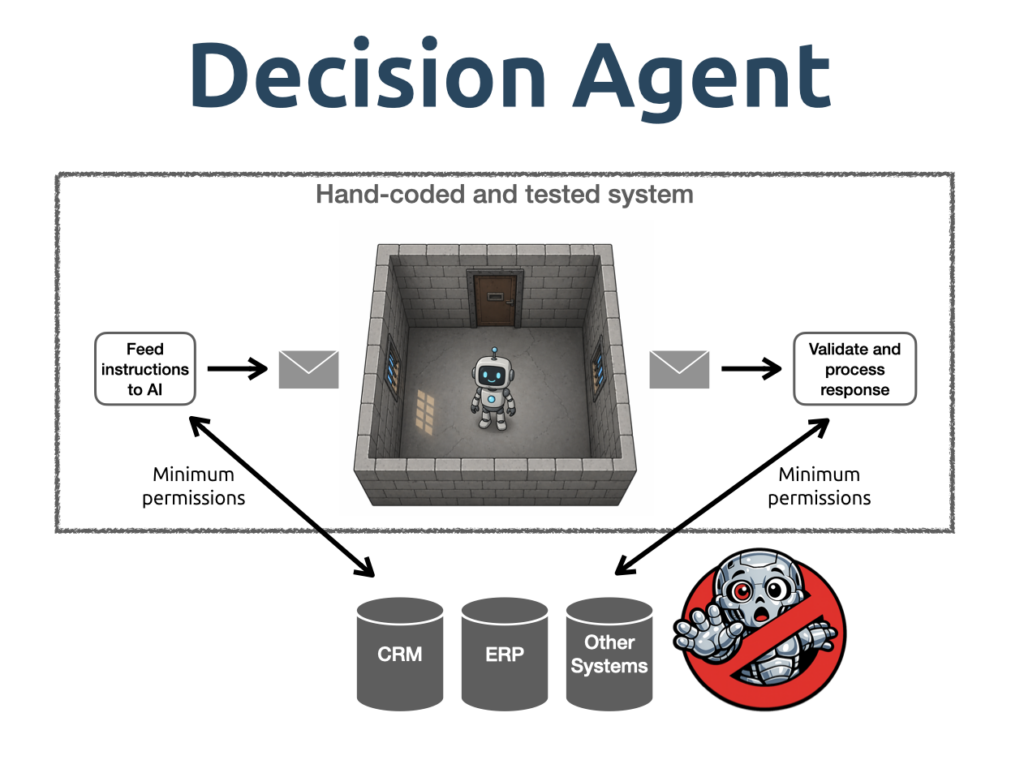
A Decision Agent is an AI agent that is focused on making a specific type of decision.
- It is sandboxed for safety/security.
- It is thoroughly tested with regression tests.
- Human feedback is used to continuously improve the prompt.
- Trust is earned - just like a junior employee who is not trusted until they prove themselves.
- It can be wired into a workflow to replace the primitive decision capability of workflow engines.
The decision it makes can be either:
- Choosing one option from a number of predefined options (classification)
- Estimating a numerical value (integer or decimal), e.g. giving a score from 0 to 100
- Ranking given values
The reason for limiting it to making a single type of decision is for reliability and repeatability. It becomes a unit of software that can be thoroughly tested.
The reason for sandboxing it is for complete security. The agent cannot reach out to other systems to fetch data or bring about changes or actions. Instead it is fed just the data that it needs.
Its output is treated like a suggestion instead of an instruction and is validated before it is accepted. It is thoroughly tested with automated tests to ensure repeatability when the LLM model version is increased or changes to the instructions are made.
For more detail, watch the first 12 minutes of the following video:
The video above shows 45 practical examples of how such Decision Agents can be used. Use the links below to jump to a specific example in the video:
- Cross-sell opportunities
- Expense policy compliance
- Discover sales leads among general enquiries
- Email priority scoring
- Duplicate supplier detection
- Proposal quality scoring
- Customer churn signals
- Knowledge base gap detection
- Leave request validation
- Sentiment detection
- SLA breach prediction
- Incident severity classification
- Audit trail completeness
- Log anomaly detection
- KPI anomaly detection
- Repeated issue detection
- Invoice anomaly check
- Pricing anomaly detection
- CV pre-screening
- Accounts receivable risk signals
- Payment prioritisation
- VAT classification
- Ticket routing
- Lead response urgency
- Cash sale vs account sale decision
- Quote comparison
- Supplier reliability
- Lead enrichment decision
- Response suggestion approval
- Discount eligibility
- Content quality check
- Access request validation
- Lost deal signals
- Inventory anomaly detection
- Demand spike detection
- Supplier risk flag
- Interview feedback summarisation
- Escalation necessity
- Refund eligibility
- KYC document check
- Workload balancing
- Contract risk review
- Shelf stock risk
- Campaign audience inclusion
- Meeting summary and action extraction
Contact us for more information on getting this implemented for your company.